African Elephant Births at Animal Kingdom
New Baby Elephant at Disney's Animal Kingdom
(June 28, 2008)
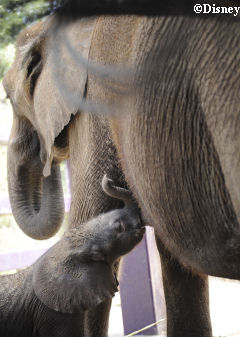
Walt Disney World Resort welcomed a newborn calf to the herd of African elephants at Disney's Animal Kingdom this weekend. Twenty-six-year-old Moyo gave birth to a 327-pound male elephant June 28 after 21 months gestation. This newest addition, which has yet to be named, is the heaviest elephant calf ever born at Disney’s Animal Kingdom. Tufani, who is Moyo’s first male calf, was born in 2003.
Read the Official WDW Press Release.
***********
Nadirah (Swahili for Precious/Rare/Gift)
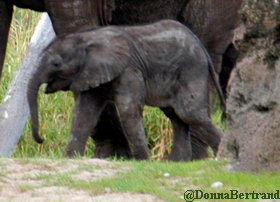
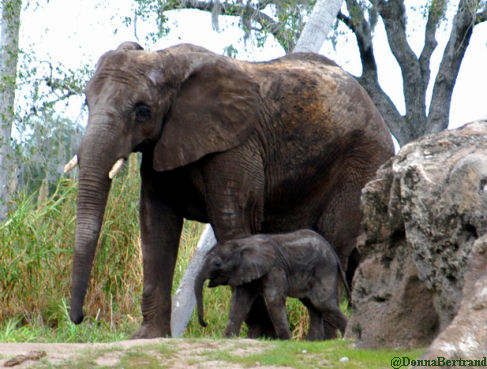
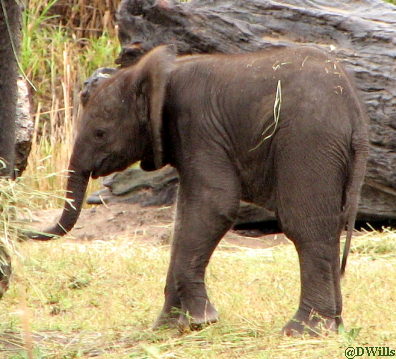
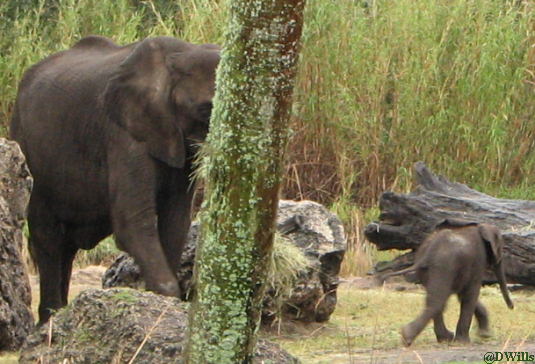
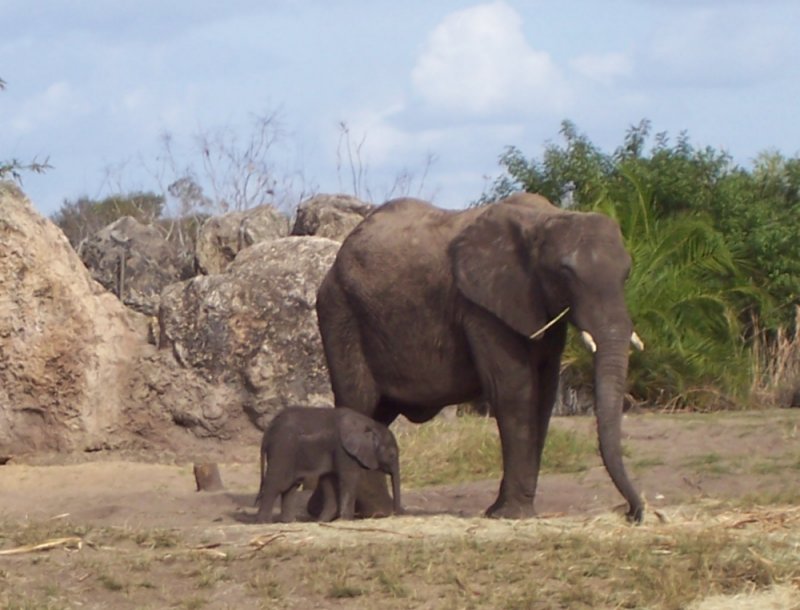
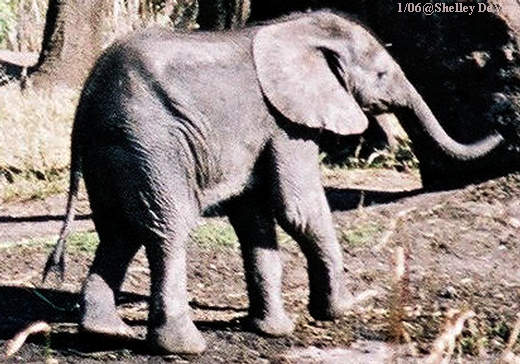
On December 19, 2005, a 233 pound female calf was born to 21 year old Donna. She is the third elephant born at Disney's Animal Kingdom.
Although she was pregant for 21 months, Mother Donna was in labor for all of 16 minutes before Nadirah was born.
Nadirah can sometimes be spotted on the savanna via the Kilimanjaro Safari attraction. She is found either very close to her mother or scampering around very quickly!
 |
 February 2006 |
 |
 |
 |
Read the official WDW Press Release about Nadirah's Birth
***********
Kianga (Swahili for Sunshine)
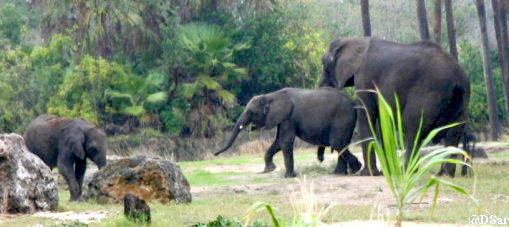
Kianga, Tufani and Adult Elephant
Kianga, a female African elephant was born July 6, 2004 weighing 230 pounds. She is the 2nd African Elephant calf born at Animal Kingdom. Kianga debuted on the savanna August 6th with her 18 year old mother Vasha.
Read the official WDW Press Release about Kianga's Birth
Tufani
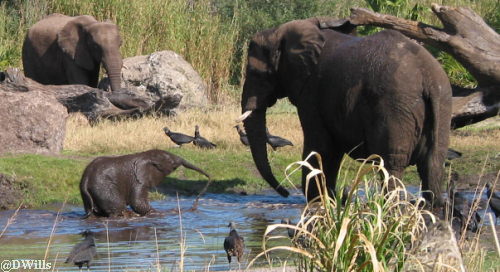
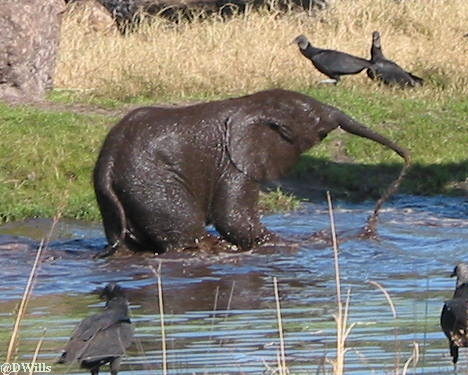
Tufani, a male, was born May 22, 2003 weighing 296 pounds at birth. He is the first African Elephant calf born at Disney's Animal Kingdom. Tufani is only the 4th surviving African elephant calf in North America to be concieved by artificial insemination.
 |
 |
Read the official WDW Press Release about Tufani's Birth
**********
Herd the News? Disney’s Animal Kingdom Welcomes Newborn Elephant
LAKE BUENA VISTA, Fla., July 1, 2008 – Walt Disney World Resort welcomed a newborn calf to the herd of African elephants at Disney's Animal Kingdom this weekend. Twenty-six-year-old Moyo gave birth to a 327-pound male elephant June 28 after 21 months gestation. This newest addition, which has yet to be named, is the heaviest elephant calf ever born at Disney’s Animal Kingdom.
“African elephants are considered endangered and are challenging to breed,” according to Jackie Ogden, vice president of Disney’s Animal Programs. “This elephant birth is significant, not only for the herd and species, but also for the dedicated team of professionals who have been working with Moyo attentively for the past two years since the early stages of her pregnancy and round-the-clock since the elephant began to show signs of an imminent birth.”
Both calf and mother appear to be doing well according to veterinarians and elephant managers, who are optimistic about the calf’s likelihood of survival. With assistance from the animal care team, the newborn became comfortable using his “newly-discovered” legs and began nursing successfully from his mother soon after birth. He is already feisty and very active.
Moyo became pregnant through artificial insemination in September 2006 and received extensive pre-natal care throughout her pregnancy. Zookeepers added more exercise to her morning routine, and in addition to regular ultrasounds, veterinarians and elephant managers monitored her hormone levels on a daily basis to help them determine when she would give birth. Labor appeared imminent late last week and the animal care team remained with her throughout the process until the male calf was born Saturday evening around 8:20 p.m.
This is the fourth elephant born at Disney’s Animal Kingdom. Tufani, who is Moyo’s first male calf, was born in 2003; Kianga, a female, was born in 2004; and Nadirah, the youngest female, joined the herd in 2005. All remain on the savannah at Disney’s Animal Kingdom.
Disney’s Animal Kingdom is part of a breeding program coordinated by the Association of Zoos and Aquariums (AZA) that is focused on sustaining the elephant population in North America. AZA’s Elephant Species Survival Plan has called for a five-fold increase in African elephant reproduction efforts – using both natural and artificial breeding methods – in order to create a self-sustaining elephant population among North American zoos and wildlife centers.
********************
It's a Girl! Third Baby African Elephant Calf Born At Disney's Animal Kingdom Park
LAKE BUENA VISTA, Fla., Dec. 20, 2005 /PRNewswire/ — The Walt Disney World Resort's animal care team welcomed a 233-pound bundle of joy to Disney's Animal Kingdom earlier this week. The female African elephant calf arrived early Monday morning, and joins her 21-year-old mother Donna after 21 months (gestation) in the womb. The calf has not yet been named.
Both the calf and her mother are doing well according to veterinarians and elephant managers, who are cautiously optimistic about the calf's likelihood for survival. The first-time mother experienced a very short labor, lasting approximately 16 minutes. With assistance from the animal care team, the newborn became comfortable using her "newly-discovered" legs and began nursing successfully from Mom soon after her birth. She is already feisty and very active.
"African elephants are endangered and difficult to breed, and having a successful birth is a significant event both for the species and for our talented and experienced team of elephant experts who have been working on this breeding program for more than five years," said Dr. Beth Stevens, vice president of Disney's Animal Kingdom Theme Park and President of the American Zoo and Aquarium Association (AZA). Donna, who is on permanent loan from the Albuquerque Zoo, became pregnant through natural breeding on March 17, 2004, when she mated with Jackson, a bull here on breeding loan from the Pittsburgh Zoo. This arrangement is part of the AZA Elephant Species Survival Plan (SSP), a consortium of zoos and wildlife parks working cooperatively to conserve elephants.
"The next critical milestone is for the calf to continue the bonding process with her mother who will teach her important lessons and protect her as she is introduced to the herd," said John Lehnhardt, animal operations director for Disney's Animal Kingdom Theme Park. Going forward, the focus of the elephant managers and veterinarians at Disney's Animal Kingdom will be on the health and welfare of the calf and Donna.
In the near future, Guests will be able to see the calf's progress on camera monitors at Rafiki's Planet Watch at Disney's Animal Kingdom. It will be several weeks before the calf and her mother will join other elephants on the savanna.
Lehnhardt noted that breeding African elephants is a challenging process, so it is especially exciting that this is the third African elephant to be born at Disney's Animal Kingdom Theme Park. A male calf, Tufani, was born in May 2003 and has gained nearly 1,500 pounds in his first two and a half years, and Kianga, a female born in July 2004, has gained more than 500 pounds in her first year. Lehnhardt said because many of the elephants giving birth in zoos and wildlife parks are first-time mothers — just as several of the elephant cows at Disney's Animal Kingdom are — it is not unusual for the animals (both in the wild and in wildlife parks) to lose their first calf either through a still birth or following the birth. He is optimistic that observation and interaction with Tufani have helped the other elephants gain additional maternal knowledge, thus improving the success rate for the Animal Kingdom breeding program.
Importance of Breeding Programs
African elephants are classified as endangered species by IUCN, the World Conservation Union, and their future in zoos and wildlife parks is complicated as the aging pachyderm population in North American zoos passes its reproductive prime. Disney's Animal Kingdom has a breeding program that is part of a cooperative effort coordinated by the AZA that is focused on sustaining the elephant population in North America. AZA's Elephant Species Survival Plan (SSP) has called for a five-fold increase in African elephant reproduction efforts — using both natural and artificial breeding methods — in order to create a self-sustaining elephant population among North American zoos and wildlife centers.
Preparing for a newborn
In the same way that people prepare their homes for a newborn baby, the staff at Disney's Animal Kingdom took steps to "baby proof" the elephant habitat to ensure that there were no hazards for a young elephant calf. The team has taken a critical look at the habitat and made many changes, including planting more trees and shrubbery for shading purposes, closing gaps between boulders, and the installation of a shallow pool behind the scenes where the calf will be able to explore the water and learn to swim in a safe environment.
High-Tech Pregnancy
Donna received extensive pre-natal care during her pregnancy. In addition to regular ultrasounds, veterinarians and elephant managers monitored her hormonal levels on a daily basis to help them determine when she would give birth. She has been receiving around-the-clock attention from the animal care > team over the past few weeks as the birth became imminent.
Disney's Animal Kingdom Theme Park is accredited by the American Zoo and Aquarium Association (AZA). With its more than 200 accredited members, AZA is a leader in global wildlife conservation and your link to helping animals in their native habitats. For more information, visit http://www.aza.org.
**********
Baby Elephant Born!
It's a Girl! Second Baby African Elephant Calf Born At Disney's Animal Kingdom Park
LAKE BUENA VISTA, Fla. (July 7, 2004) — The Walt Disney World Resort's animal care team welcomed a 230 pound bundle of joy to Disney's Animal Kingdom earlier this week. The female African elephant calf arrived Tuesday evening to join its 18-year-old mother Vasha after 22 months (gestation) in the womb. Kianga is her name, which means "Sunshine" in Swahili.
Both Kianga and her mother appear to be doing well according to veterinarians and elephant managers, who are cautiously optimistic about the calf's likelihood for survival. The first-time mother experienced a very short labor. With assistance from the animal care team, the newborn became comfortable using her "newly-discovered" legs and began nursing successfully from Mom soon after her birth. She is already feisty and very active.
"African elephants are endangered and difficult to breed, and having a successful birth is a significant event both for the species and for our talented and experienced team of elephant experts who have been working on this breeding program for more than five years," said Dr. Beth Stevens, vice president of Disney's Animal Kingdom Theme Park. Vasha, who is on loan from the Dallas Zoo, became pregnant through natural breeding on October 4, 2002, when she mated with Jackson, a bull here on breeding loan from the Pittsburgh Zoo. This arrangement is part of the American Zoo and Aquarium Association (AZA) Elephant Species Survival Plan (SSP), a consortium of zoos and wildlife parks working cooperatively to conserve elephants.
"The next critical milestone is for Kianga to continue the bonding process with her mother who will teach her important lessons and protect her as she is introduced to the heard," said John Lehnhardt, animal operations director for Disney's Animal Kingdom Theme Park. Going forward, the focus of the elephant managers and veterinarians at Disney's Animal Kingdom will be on the health and welfare of Kianga and her mother.
In the near future, Guests will be able to see the Kianga's progress on camera monitors at Rafiki's Planet Watch at Disney's Animal Kingdom. It will be several weeks before the calf and her mother will join other elephants on the savanna.
Lehnhardt noted that breeding African elephants is a challenging process, so it is especially exciting that this is the second African elephant to be born at Disney's Animal Kingdom Theme Park. A male calf, Tufani, was born in May 2003 and has gained nearly 600 pounds in its first year of growth. Lehnhardt said that because many of the elephants giving birth in zoos and wildlife parks are first-time mothers — just as several of the elephant cows at Disney's Animal Kingdom are — it is not unusual for the animals (both in the wild and in wildlife parks) to lose their first calf, either through a still birth or following the birth. He is optimistic that observation and interaction with Tufani has helped the other elephants gain additional maternal knowledge, thus improving the success rate for the Animal Kingdom breeding program. Two other elephants at Disney's Animal Kingdom are pregnant and due in 2005; one is expected next spring and the other in late winter.
**********
Disney's Animal Kingdom Trumpets Precious Pachyderm Arrival
First-Ever Baby African Elephant Calf Born at Disney's Animal Kingdom is a Boy
May 23, 2003 — The Walt Disney World Resort's animal care team welcomed the first African elephant calf to be born at Disney's Animal Kingdom Theme Park last night. The 296-pound bundle of joy was born at 10:05 p.m. to its 22-year-old mother Moyo. The first-time mother was in labor on and off for four hours before giving birth to the calf, which was conceived through artificial insemination on August 25, 2001. This is the fourth surviving African elephant calf in North America to have resulted from an artificial insemination procedure.
"There has been great anticipation around this birth for a very long time," said Dr. Beth Stevens, vice president of Disney's Animal Kingdom Theme Park. "African elephants are endangered and difficult to breed, and having a successful birth is a significant event both for the species and for our talented and experienced team of elephant experts who have been working on a breeding program at our park for more than two years. It is especially meaningful to welcome the birth of our first elephant calf to Disney's Animal Kingdom in the year that we celebrate our fifth anniversary."
Both the calf and the mother are doing fine so far according to veterinarians and elephant managers, who are cautiously optimistic about the calf's likelihood for survival. With assistance from the animal care team, the newborn male stood on its wobbly legs and took its first steps within its first hour of life.
"The next critical milestone is for the mother to accept the calf and for nursing to begin," said John Lehnhardt, animal operations director for Disney's Animal Kingdom Theme Park. "We worked through the night to help that process along and will continue to do so. In the meantime, we are bottle feeding the calf, and he has a very healthy appetite."
Lehnhardt noted that breeding African elephants is a challenging process. One reason is because many of the elephants giving birth in zoos and wildlife parks are first-time mothers – just as the elephant at Disney's Animal Kingdom is — and it is not unusual for first-time elephant mothers both in the wild and in wildlife parks — to lose their first calf, either through a still birth or following the birth.
Last month, veterinarians and elephant managers at Disney's Animal Kingdom were deeply saddened after they determined that another pregnant African elephant named Robin lost her calf in the womb. Robin was in labor off and on for two days, and many unsuccessful attempts were made to induce productive labor until it was concluded that the calf had died. One other elephant at Disney's Animal Kingdom is pregnant and is expected to give birth next summer.
Going forward, the focus of the elephant managers and veterinarians at Disney's Animal Kingdom will be on the health and welfare of the calf and mother. It is too soon to say when the baby will be on the savannah for Guests to view, but in the near future, Guests will be able to see the progress of the little one on camera monitors at Rafiki's Planet Watch at Disney's Animal Kingdom.
Importance of Breeding Programs
African elephants are classified as endangered species by IUCN, the World Conservation Union, and their future in zoos and wildlife parks is complicated as the aging pachyderm population in North American zoos passes its reproductive prime.
Disney's Animal Kingdom has a breeding program that is part of a cooperative effort coordinated by the American Zoo and Aquarium Association (AZA) that is focused on sustaining the elephant population in North America.
AZA's Elephant Species Survival Plan (SSP) has called for a five-fold increase in African elephant reproduction efforts – using both natural and artificial breeding methods – in order to create a self-sustaining elephant population among North American zoos and wildlife centers.
Artificial insemination is playing an important role in the effort to breed elephants in North America, particularly because it allows for elephant reproduction at zoos and wildlife parks without having to move animals from one place to another to attempt reproduction naturally.
High Tech Pregnancy – Moyo received extensive prenatal care during her pregnancy. In addition to regular ultrasounds, veterinarians and elephant managers monitored her hormonal levels on a daily basis to help them determine when she would give birth. She has been receiving around-the-clock attention from the animal care team over the past few weeks as the birth became imminent.
Busy Week at Disney's Animal Kingdom – Things have been unusually busy as Disney's Animal Kingdom over the past week. In addition to the birth of the elephant calf, the animal care team has also welcomed the birth of a healthy baby hippo, a siamang ape, which was born via caesarian section and two wildebeest calves.